One Executive Headshot, Two Front Doors: How Tony Page Uses His Portrait
An executive headshot does its real work after delivery, in the places people meet you before they meet you. Tony Page, Founder and CEO of Sipher6, uses the same portrait on his company's leadership page and on his LinkedIn profile. One consistent image lets a prospective partner recognize him in both places, and that recognition is the first step toward trust.
This is the first Proof of Presence feature in the Journal: one client, one photograph, and the real places it now lives.
Tony came to the studio with a deadline. Sipher6's new website was being built and was due to launch within days, and it needed a portrait of the person behind the company. The photograph had one job before it had any other: be ready for that launch.
Where does an executive headshot actually get seen?
Most often, on two pages: the company website and LinkedIn.
A leadership page is where a prospective partner goes to find out who is behind the company. A LinkedIn profile is where the same person goes to find out who you are when you are not on your own website. Both are front doors. Neither one gives you a chance to explain yourself in person.
Tony's portrait sits in both.
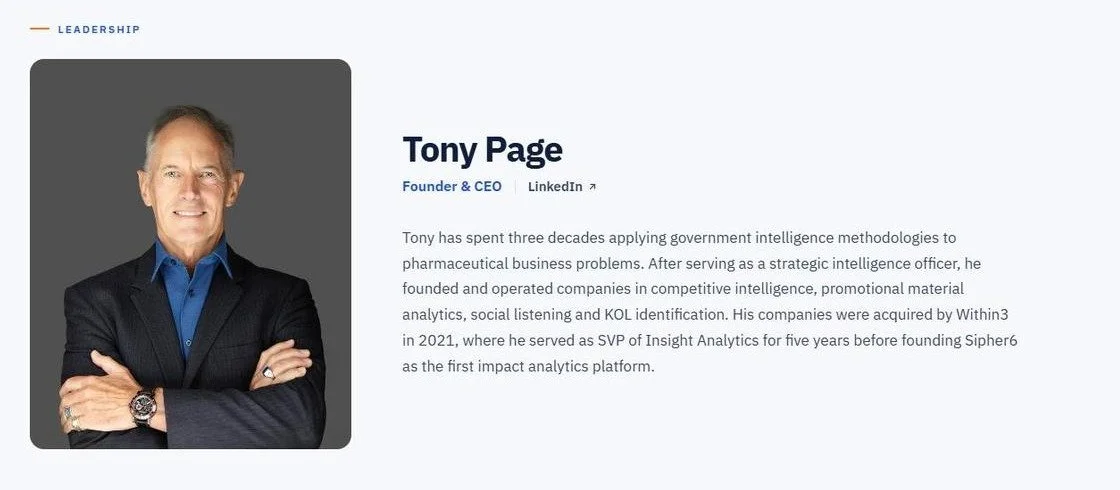
On sipher6.com, it opens the Leadership section. His name, his title and his background sit beside it: three decades applying government intelligence methods to pharmaceutical business problems, earlier companies acquired by Within3 in 2021, and five years there as SVP of Insight Analytics before he founded Sipher6.
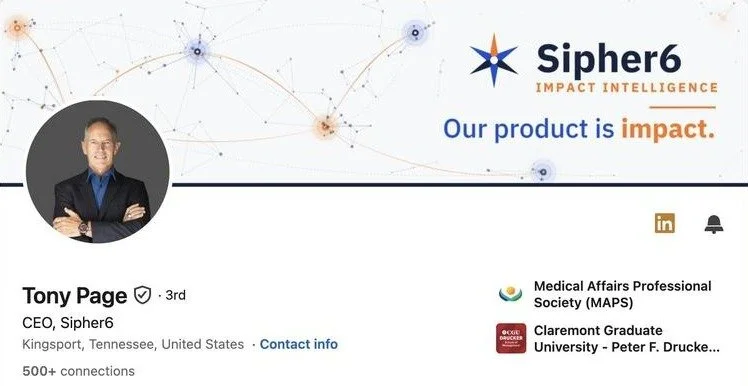
On his LinkedIn profile, the same portrait sits in the profile circle, beneath a Sipher6 banner that reads "Our product is impact."
Why does the same portrait matter in both places?
Because recognition is the first step toward trust.
Picture someone reading the Sipher6 leadership page this morning and Tony's LinkedIn profile this afternoon. When it is the same face, the same expression and the same jacket, nothing makes them stop and wonder whether this is the same person. They simply keep reading.
That matters more for some companies than others. Sipher6 serves biopharmaceutical companies. Its work, as its own site describes it, is mapping the actual structure of a disease community and identifying who moves it. A buyer weighing that kind of work is not only evaluating a platform. They are deciding whether to trust the judgment of the person who built it.
A mismatched set of photographs does not ruin that decision. It just adds a small question that did not need to be there.
What does the portrait itself communicate?
Composure, and approachability at the same time.
Tony stands against a quiet charcoal background in a dark jacket and a blue open-collar shirt, arms crossed, with an easy, direct smile.
The crossed arms were his. He did it naturally, without being asked, and when I saw it I knew that was the real Tony. Crossed arms can read as guarded. Here they read as settled, because the expression does the deciding. The background stays out of the way, so the face leads.
None of that is accidental, and none of it is dramatic. The difference is not dramatic. It is deliberate.
How does one photograph work in a rectangle and a circle?
It works because there is room around the subject.
The delivered file is a horizontal frame with generous space on each side of Tony. The Sipher6 site crops it into a tall card with rounded corners. LinkedIn crops it into a small circle. The same photograph holds up in both because the face sits where both crops can find it, and the background is plain enough to disappear at any size.
That is worth thinking about before your session, not after. If you know where your image will live, it can be composed so it survives every shape it will be cut into.
Why did the session feel easy?
Because he did not have to work at it.
I did not spend the session correcting Tony. I gave gentle guidance based on what he was already doing right, and built from there. When something did not look right to me, I did not dwell on it. I simply said, "Let's try this instead," and we moved on.
That approach matters most when there is a deadline. A person who is being corrected starts performing. A person who is being shown what already works relaxes, and the camera sees the difference.
What did Tony say about the experience?
He put it in his own words in a Google review:
"I can't express how impressed I was with Yevette's professionalism, skill and attention to detail. I've had corporate headshots done before but I have never experienced this level of talent. I also appreciated that Yevette is clearly passionate about her art and sincerely cares. As a bonus, she even managed to make the experience fun."
I include it here as he wrote it, apart from one spelling correction and lighter punctuation. The more useful evidence is on his website and his LinkedIn profile. A portrait that is still in use is the clearest sign that it was the right one.
For the person updating a company leadership page
If you are responsible for your company's leadership or team page, Tony's example points to a simple standard: each person should look the same on the company site as they do on their own LinkedIn profile.
A few practical steps:
Collect each leader's current LinkedIn photo alongside the image on the company site, and compare them side by side.
Note where the two do not match: different years, different settings, different crops.
Plan new portraits with both placements in mind, a tall card and a circle.
Keep backgrounds and framing consistent across the team, so the page reads as one company.
If the page includes several people, planning team headshots together makes that consistency much easier to keep.
What is Proof of Presence?
Proof of Presence is how I document what happens to a photograph after it leaves the studio. Delivery is the beginning of an image's working life, not the end of the session.
Each feature follows one client and one real use: a leadership page, a LinkedIn profile, a podcast thumbnail, a speaker introduction. I describe where the image lives and why that placement matters. I do not claim results that I cannot see.
If you have had a session with me here in Kingsport and are using your photographs somewhere interesting, I would like to hear where.
Frequently asked questions
Should I use the same headshot on my company website and my LinkedIn profile?
In most cases, yes. When the same portrait appears in both places, people recognize you immediately and keep reading, rather than pausing to reconcile two different images of the same person.
Will one headshot work in both a rectangular crop and a circular crop?
It will if the photograph leaves room around you and keeps the background plain. Tony's portrait is a horizontal frame that his website crops into a tall card and LinkedIn crops into a small circle, and it holds up in both.
What should a leadership page photograph communicate?
It should tell a prospective partner that you are credible, current and approachable before they read a word of your biography. A quiet background lets your expression lead.
How do I know whether my headshot is still doing its job?
Look at where it actually appears. If your website, LinkedIn profile and speaker materials show different years or different versions of you, the image is no longer working as one introduction.
What if I need a headshot for a website that launches soon?
Tell me the launch date and where the image will appear when you book. A headshot session takes less than 30 minutes, and you choose your images in the studio, so the planning can focus on the placements your site needs.
Can my headshot be featured in a Proof of Presence story?
If you are a past client and your photograph is in use somewhere that matters to your work, reply to my newsletter or contact the studio. I feature one real use at a time.
A quiet close
A portrait earns its place by being the one people keep seeing.
Watch this week's Professional Image Minute.